| Plate
|
-
 © Museums Victoria, CC BY 4.0, via Wikimedia Commons · CC BY 4.0
|
-
 © Chan T. Y. & Lin C. W.; MNHN, CC BY 4.0, via Wikimedia Commons · CC BY 4.0
|
Each has its own |
| Stable identifier
|
|
|
Each has its own |
| Taxonomic rank
|
|
|
Same |
| Authority and year
|
|
|
Differs |
| English name
|
The register holds no verified English name for this taxon.
|
|
Only the second has a record |
| Nationally approved Arabic name
|
No nationally approved Arabic name exists for this taxon; verified local names are shown in the next two rows, as what they are.
|
No nationally approved Arabic name exists for this taxon; verified local names are shown in the next two rows, as what they are.
|
Neither has a record |
| Local name — Red Sea
A name recorded for this sea; it is not an occurrence record. |
No verified local name is recorded for the Red Sea.
|
No verified local name is recorded for the Red Sea.
|
Neither has a record |
| Local name — Arabian Gulf
A name recorded for this sea; it is not an occurrence record. |
No verified local name is recorded for the Arabian Gulf.
|
No verified local name is recorded for the Arabian Gulf.
|
Neither has a record |
| Family
|
|
|
Same |
| Order
|
|
|
Same |
| National code
|
This record carries no national code.
|
This record carries no national code.
|
Neither has a record |
| Measured specimen length
The length of a measured specimen, not the maximum length of the species. |
The register holds no measured specimen length.
|
The register holds no measured specimen length.
|
Neither has a record |
| Published conservation status
|
No conservation assessment is published for this record.
|
No conservation assessment is published for this record.
|
Neither has a record |
| Distribution
|
-
Saudi Arabian Gulf coast: preserved specimens held by the Smithsonian National Museum of Natural History (USNM) and published through GBIF, among them Safaniya (north of Safaniya Hill) (1982), Jurayd Island (north-east end) (1981), Abu Ali Island (1971). The GBIF records give Isabel Pérez Farfante as the determiner. Museum specimen records: not an estimate of abundance and not a statement about the species today.
Saudi territorial waters, Arabian Gulf
Reference 120 — Occurrence record · verified
the evidence is a rendering of what the locator holds, not a verbatim quotation
Reference 121 — Occurrence record · verified
the evidence is a rendering of what the locator holds, not a verbatim quotation
Reference 122 — Occurrence record · verified
the evidence is a rendering of what the locator holds, not a verbatim quotation
-
According to the FAO sheet (1983): within the area from south-east Africa to the Gulf of Oman and the “Gulf”, the Red Sea, Madagascar, Mauritius, La Réunion and Seychelles; also the southern coast of India and Sri Lanka; further east from Burma to Korea and Japan, New Guinea, Australia and Fiji. A regional statement; the Saudi Gulf record of the species is the specimens named above.
Reference 110 — Penaeus (Melicertus) latisulcatus sheet: geographical distribution · verified
the evidence is a rendering of what the locator holds, not a verbatim quotation
|
-
Metapenaeus monoceros is the second most abundant commercially important shrimp species caught along the Saudi Arabian Red Sea coast … fishery-independent samples collected from shrimp trawling grounds off Al Qunfudhah and Jizan (October 2022–September 2023). Altogether, 10,859 specimens were examined.
Saudi territorial waters, Red Sea
Reference 12 — Abstract · verified
the evidence is a rendering of what the locator holds, not a verbatim quotation
-
According to the FAO sheet (1983): occurs throughout the area from South Africa to south India, including the Red Sea, Madagascar, Mauritius, La Réunion and Sri Lanka, but is “absent from the Gulf”; further east as far as the Malay Peninsula; it has entered the eastern Mediterranean through the Suez Canal. A regional statement; no range on the Saudi Gulf coast is attributed to the species.
Reference 110 — Metapenaeus monoceros sheet: geographical distribution · verified
the evidence is a rendering of what the locator holds, not a verbatim quotation
|
Differs |
| Morphology
|
-
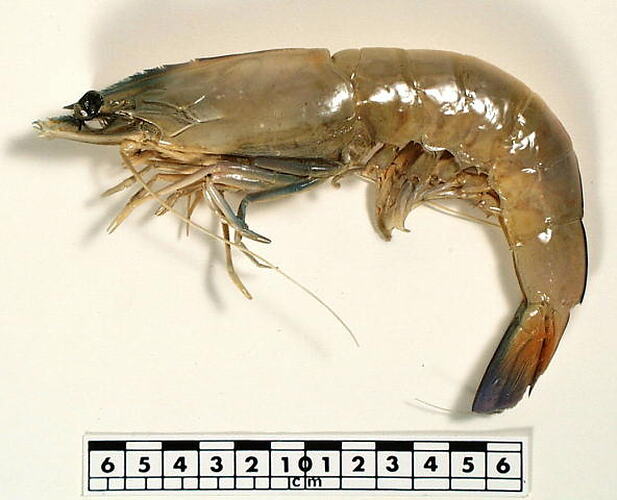
According to the FAO identification sheet (western Indian Ocean, 1983): carapace smooth; rostrum with 9 to 12 teeth on the dorsal margin and a single tooth on the ventral margin; gastrofrontal crest present; telson armed with 3 pairs of movable spines; no ischial spine on the first pereopod. Colour: body pale yellow to brown; dorsal crests dark brown; the pleura of the first 5 abdominal segments each with a short vertical red or brown stripe. A description for the western Indian Ocean (FAO Area 51), not a Saudi study.
Reference 110 — Penaeus (Melicertus) latisulcatus sheet: distinctive characters · verified
the evidence is a rendering of what the locator holds, not a verbatim quotation
|
-
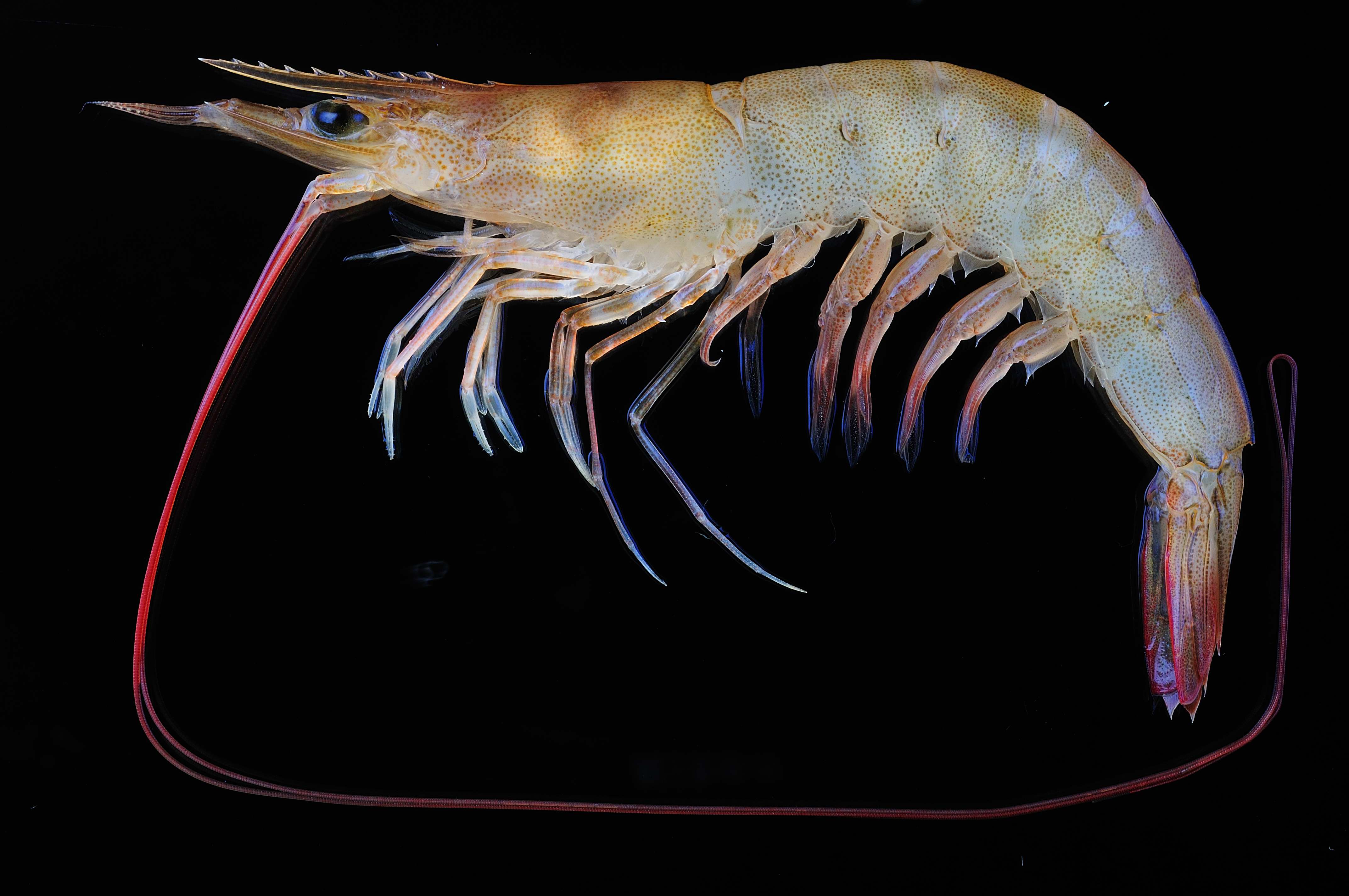
According to the FAO identification sheet (western Indian Ocean, 1983): almost the entire body is pubescent (in East Africa, except the Red Sea, the pubescence is restricted to the dorsal part of the carapace and abdominal patches); rostrum with 9 to 12 teeth along the entire dorsal margin, straight, reaching as far as or beyond the tip of the antennular peduncle; telson armed only with spinules; a small ischial spine on the first pereopod. Colour: body pink, green-greyish or whitish with brown specks; antennae red. A description for the western Indian Ocean (FAO Area 51), not a Saudi study.
Reference 110 — Metapenaeus monoceros sheet: distinctive characters · verified
the evidence is a rendering of what the locator holds, not a verbatim quotation
|
Differs |
| Habitat and distribution
|
-
According to the FAO sheet (1983): found from the coastline to depths of about 80 m, occasionally deeper, on sand or mud, with a clear preference in many localities for sandy substrates; nocturnal, burying in the seabed in daytime and emerging at night to feed. A description for the western Indian Ocean (FAO Area 51), not a Saudi study.
Reference 110 — Penaeus (Melicertus) latisulcatus sheet: geographical distribution and behaviour · verified
the evidence is a rendering of what the locator holds, not a verbatim quotation
|
-
According to the FAO sheet (1983): usually found from the coast to about 70 m (fished down to 170 m in an exploratory survey off Pakistan), mainly on mud, sandy-mud or silt; juveniles live in estuaries and backwaters or close to the shore. A description for the western Indian Ocean (FAO Area 51), not a Saudi study.
Reference 110 — Metapenaeus monoceros sheet: geographical distribution and behaviour · verified
the evidence is a rendering of what the locator holds, not a verbatim quotation
|
Differs |
| Identity and names
|
-
WoRMS records the name Penaeus latisulcatus Kishinouye, 1896 as a “superseded combination”, its accepted name being Penaeus (Oleopenaeus) latisulcatus; the encyclopedia keeps the genus Penaeus as it does for its other species. Penaeus hathor is a separate accepted species that was originally described as a subspecies of P. latisulcatus.
Reference 14 — AphiaRecordsByName, retrieved 17 October 2026 · verified
the evidence is a rendering of what the locator holds, not a verbatim quotation
|
The register holds no row for this field.
|
Only the first has a record |
| Carapace length (observed range)
|
The register holds no row for this field.
|
-
7.98 – 49.1 mm
Saudi territorial waters, Red Sea
Reference 12 — Table 1 (Results 3.1–3.2) · verified
the evidence is a rendering of what the locator holds, not a verbatim quotation
-
7.98 – 49.1 mm
Saudi territorial waters, Red Sea
Reference 12 — Table 1 (Results 3.1–3.2) · verified
the evidence is a rendering of what the locator holds, not a verbatim quotation
-
8.4 – 37.56 mm
Saudi territorial waters, Red Sea
Reference 12 — Table 1 (Results 3.1–3.2) · verified
the evidence is a rendering of what the locator holds, not a verbatim quotation
|
Only the second has a record |
| Body weight
|
The register holds no row for this field.
|
-
0.41 – 41.28 g
Saudi territorial waters, Red Sea
Reference 12 — Table 1 (Results 3.1–3.2) · verified
the evidence is a rendering of what the locator holds, not a verbatim quotation
-
0.41 – 41.28 g
Saudi territorial waters, Red Sea
Reference 12 — Table 1 (Results 3.1–3.2) · verified
the evidence is a rendering of what the locator holds, not a verbatim quotation
-
0.46 – 25.88 g
Saudi territorial waters, Red Sea
Reference 12 — Table 1 (Results 3.1–3.2) · verified
the evidence is a rendering of what the locator holds, not a verbatim quotation
|
Only the second has a record |
| Asymptotic length (L∞)
|
The register holds no row for this field.
|
-
50.66 mm
Saudi territorial waters, Red Sea
Reference 12 — Results 3.5 · verified
the evidence is a rendering of what the locator holds, not a verbatim quotation
-
38.97 mm
Saudi territorial waters, Red Sea
Reference 12 — Results 3.5 · verified
the evidence is a rendering of what the locator holds, not a verbatim quotation
|
Only the second has a record |
| Growth coefficient (K)
|
The register holds no row for this field.
|
-
0.35 /yr
Saudi territorial waters, Red Sea
Reference 12 — Results 3.5 · verified
the evidence is a rendering of what the locator holds, not a verbatim quotation
-
0.55 /yr
Saudi territorial waters, Red Sea
Reference 12 — Results 3.5 · verified
the evidence is a rendering of what the locator holds, not a verbatim quotation
|
Only the second has a record |
| Total mortality (Z)
|
The register holds no row for this field.
|
-
2.38 /yr
Saudi territorial waters, Red Sea
Reference 12 — Results 3.5 · verified
the evidence is a rendering of what the locator holds, not a verbatim quotation
-
3.65 /yr
Saudi territorial waters, Red Sea
Reference 12 — Results 3.5 · verified
the evidence is a rendering of what the locator holds, not a verbatim quotation
|
Only the second has a record |
| Natural mortality (M)
|
The register holds no row for this field.
|
-
0.96 /yr
Saudi territorial waters, Red Sea
Reference 12 — Results 3.5 · verified
the evidence is a rendering of what the locator holds, not a verbatim quotation
-
1.45 /yr
Saudi territorial waters, Red Sea
Reference 12 — Results 3.5 · verified
the evidence is a rendering of what the locator holds, not a verbatim quotation
|
Only the second has a record |
| Fishing mortality (F)
|
The register holds no row for this field.
|
-
1.42 /yr
Saudi territorial waters, Red Sea
Reference 12 — Results 3.5 · verified
the evidence is a rendering of what the locator holds, not a verbatim quotation
-
2.2 /yr
Saudi territorial waters, Red Sea
Reference 12 — Results 3.5 · verified
the evidence is a rendering of what the locator holds, not a verbatim quotation
|
Only the second has a record |
| Exploitation rate (E)
|
The register holds no row for this field.
|
-
0.6
Saudi territorial waters, Red Sea
Reference 12 — Results 3.6 · verified
the evidence is a rendering of what the locator holds, not a verbatim quotation
|
Only the second has a record |
| Size at first maturity
|
The register holds no row for this field.
|
-
21.12 mm
Saudi territorial waters, Red Sea
Reference 12 — Results 3.3 (95% CI 20.91–21.29 mm) · verified
the evidence is a rendering of what the locator holds, not a verbatim quotation
|
Only the second has a record |
| Spawning potential ratio
|
The register holds no row for this field.
|
-
0.23
Saudi territorial waters, Red Sea
Reference 12 — Results 3.6; Figure 6 · verified
the evidence is a rendering of what the locator holds, not a verbatim quotation
|
Only the second has a record |
| Sex ratio
|
The register holds no row for this field.
|
-
1.56 females to 1 male
Saudi territorial waters, Red Sea
Reference 12 — Results 3.3 · verified
the evidence is a rendering of what the locator holds, not a verbatim quotation
|
Only the second has a record |
| Spawning period
|
The register holds no row for this field.
|
-
Continuous year-round with a February to May peak
Saudi territorial waters, Red Sea
Reference 12 — Discussion (peak February–May) · verified
the evidence is a rendering of what the locator holds, not a verbatim quotation
|
Only the second has a record |
| Recruitment period
|
The register holds no row for this field.
|
-
Young individuals abundant from June to September
Saudi territorial waters, Red Sea
Reference 12 — Discussion (June–September) · verified
the evidence is a rendering of what the locator holds, not a verbatim quotation
|
Only the second has a record |
| Codend mesh size
|
The register holds no row for this field.
|
-
40 mm
Saudi territorial waters, Red Sea
Reference 12 — Methods 2.1–2.2 (38 mm regulated minimum) · verified
the evidence is a rendering of what the locator holds, not a verbatim quotation
|
Only the second has a record |
| General description
|
The register holds no row for this field.
|
-
Maximum total length (TL) printed by the FAO sheet (1983): males 15 cm, females 20 cm. It is a maximum recorded total length, not a common size and not a measurement made in Saudi waters; the Saudi measurements on this page are carapace lengths and are shown separately.
Reference 110 — Metapenaeus monoceros sheet: size · verified
the evidence is a rendering of what the locator holds, not a verbatim quotation
|
Only the second has a record |
| Study sample count
|
The register holds no row for this field.
|
-
10859
Saudi territorial waters, Red Sea
Reference 11 — Results 3.1 (species composition, n = 103,758 individuals, shares by number) · verified
|
Only the second has a record |
| Share of the study sample
|
The register holds no row for this field.
|
-
10 %
Saudi territorial waters, Red Sea
Reference 11 — Results 3.1 (species composition, n = 103,758 individuals, shares by number) · verified
|
Only the second has a record |
| Sources
|
-
Reference 14 — World Register of Marine Species, 2026
-
Reference 110 — FAO Species Identification Sheets for Fishery Purposes: Western Indian Ocean (Fishing Area 51), Penaeidae sheets, 1983
-
Reference 120 — GBIF occurrence 1322872448: Penaeus latisulcatus, Safaniya (north of Safaniya Hill), 1982, specimen of the Smithsonian National Museum of Natural History (USNM), 1982
-
Reference 121 — GBIF occurrence 1320675680: Penaeus latisulcatus, Jurayd Island (north-east end), 1981, specimen of the Smithsonian National Museum of Natural History (USNM), 1981
-
Reference 122 — GBIF occurrence 1321434149: Penaeus latisulcatus, Abu Ali Island, 1971, specimen of the Smithsonian National Museum of Natural History (USNM), 1971
|
-
Reference 11 — Linking Biological Parameters to Fishery Management: Stock Assessment of Green Tiger Prawn, Penaeus semisulcatus De Haan, 1844 Along the Red Sea Coast of Saudi Arabia, 2025
-
Reference 12 — Life History Traits and Fishery Dynamics of Speckled Shrimp, Metapenaeus monoceros (Fabricius, 1798), Along the Saudi Arabian Red Sea Coast, 2025
-
Reference 14 — World Register of Marine Species, 2026
-
Reference 15 — ASFIS List of Species for Fishery Statistics Purposes, 2026 edition, 2026
-
Reference 110 — FAO Species Identification Sheets for Fishery Purposes: Western Indian Ocean (Fishing Area 51), Penaeidae sheets, 1983
|
Differs |