| Plate
|
No plate is registered for this record.
|
-
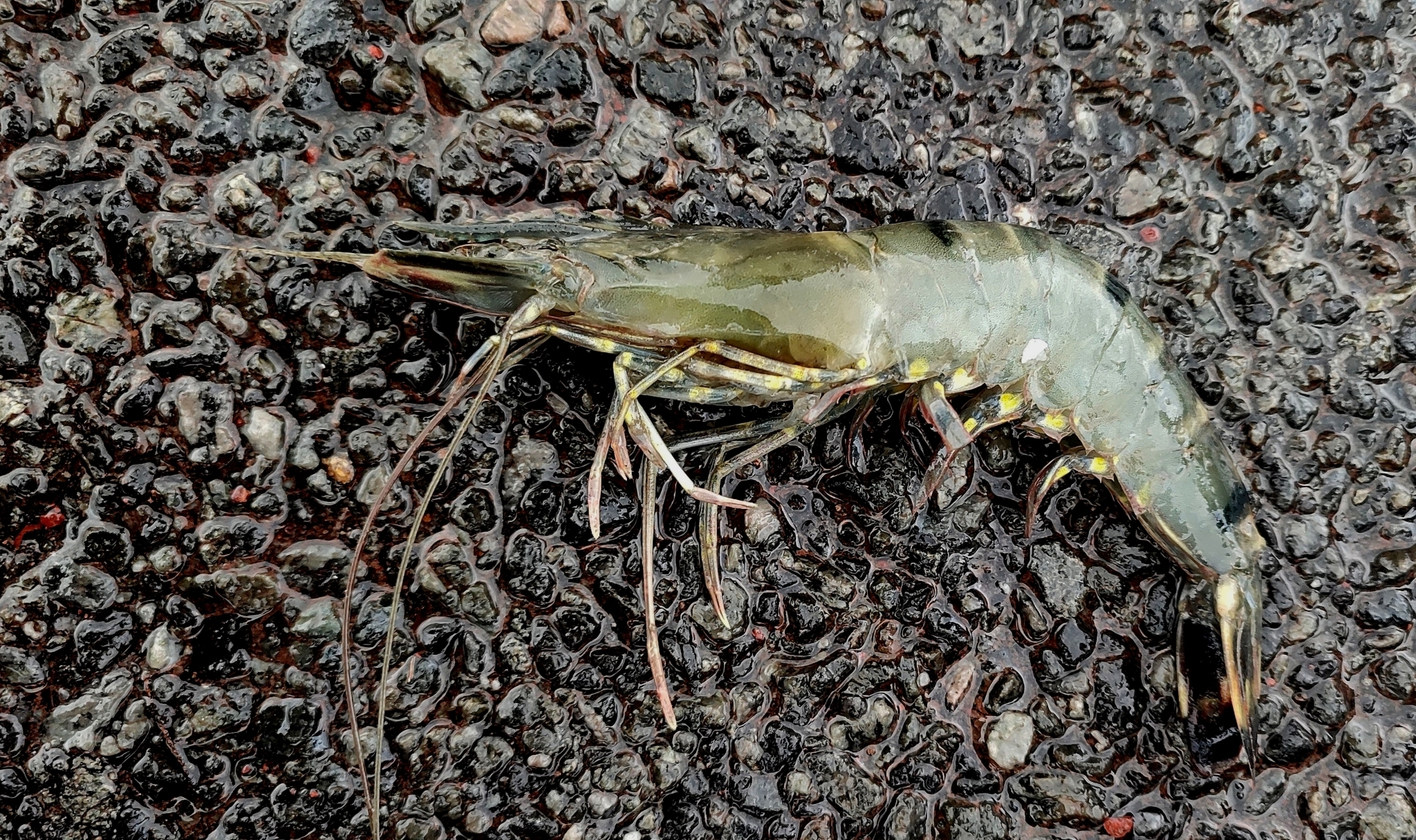 © (c) Afsar Nayakkan, some rights reserved (CC BY), via iNaturalist observation 284214961 · CC BY 4.0
|
Only the second has a record |
| Stable identifier
|
|
|
Each has its own |
| Taxonomic rank
|
|
|
Same |
| Authority and year
|
|
|
Differs |
| English name
|
The register holds no verified English name for this taxon.
|
-
giant tiger prawn
-
black tiger prawn
-
Asian tiger shrimp
|
Only the second has a record |
| Nationally approved Arabic name
|
No nationally approved Arabic name exists for this taxon; verified local names are shown in the next two rows, as what they are.
|
No nationally approved Arabic name exists for this taxon; verified local names are shown in the next two rows, as what they are.
|
Neither has a record |
| Local name — Red Sea
A name recorded for this sea; it is not an occurrence record. |
No verified local name is recorded for the Red Sea.
|
No verified local name is recorded for the Red Sea.
|
Neither has a record |
| Local name — Arabian Gulf
A name recorded for this sea; it is not an occurrence record. |
No verified local name is recorded for the Arabian Gulf.
|
No verified local name is recorded for the Arabian Gulf.
|
Neither has a record |
| Family
|
|
|
Same |
| Order
|
|
|
Same |
| National code
|
This record carries no national code.
|
This record carries no national code.
|
Neither has a record |
| Measured specimen length
The length of a measured specimen, not the maximum length of the species. |
The register holds no measured specimen length.
|
The register holds no measured specimen length.
|
Neither has a record |
| Published conservation status
|
No conservation assessment is published for this record.
|
No conservation assessment is published for this record.
|
Neither has a record |
| Identity and names
|
-
Accepted name in the World Register of Marine Species (WoRMS): Metapenaeus stebbingi Nobili, 1904.
Reference 14 — AphiaRecordsByName, retrieved 17 October 2026 · verified
the evidence is a rendering of what the locator holds, not a verbatim quotation
|
The register holds no row for this field.
|
Only the first has a record |
| Distribution
|
-
Saudi Arabian Gulf coast: preserved specimens held by the Smithsonian National Museum of Natural History (USNM) and published through GBIF, among them Manifa Bay (1982), Safaniya (1972), Dammam (1971). The GBIF records give Isabel Pérez Farfante as the determiner. Museum specimen records: not an estimate of abundance and not a statement about the species today.
Saudi territorial waters, Arabian Gulf
Reference 117 — Occurrence record · verified
the evidence is a rendering of what the locator holds, not a verbatim quotation
Reference 118 — Occurrence record · verified
the evidence is a rendering of what the locator holds, not a verbatim quotation
Reference 119 — Occurrence record · verified
the evidence is a rendering of what the locator holds, not a verbatim quotation
-
According to the FAO sheet (1983): all along the coast from South Africa to the Gulf of Kutch in north-west India, including the Red Sea and the “Gulf”, and along the west coast of Madagascar; it has entered the eastern Mediterranean through the Suez Canal. A regional statement; the Saudi Gulf record of the species is the specimens named above.
Reference 110 — Metapenaeus stebbingi sheet: geographical distribution · verified
the evidence is a rendering of what the locator holds, not a verbatim quotation
|
-
Saudi Red Sea: recorded but rare, 17 individuals (0.02% by number) in the fishery-independent trawl surveys off Jizan and Al Qunfudhah, October 2022 to September 2023.
Saudi territorial waters, Red Sea
Reference 11 — Results 3.1 · verified
-
According to the FAO sheet (1983): within the area from south and east Africa to the Gulf of Aden and the Red Sea, the west coast of Madagascar, Mauritius and La Réunion, and from Pakistan to south India and Sri Lanka, extending east as far as China and Japan, the Philippines, New Guinea and Australia. A regional statement that does not name Saudi Arabia.
Reference 110 — Penaeus (Penaeus) monodon sheet: geographical distribution · verified
the evidence is a rendering of what the locator holds, not a verbatim quotation
|
Differs |
| Morphology
|
-
According to the FAO identification sheet (western Indian Ocean, 1983): body almost entirely hairless; rostrum with 7 to 10 teeth along the entire dorsal margin, reaching only the distal margin of the second antennular article in specimens from the “Gulf”; telson armed on each side with a row of small movable spines; no ischial spine on the first pereopod. Colour: body, pereopods and pleopods white to creamy-yellow with grey and rust-coloured specks; antennae and distal part of the uropods rusty to grey-purplish. A description for the western Indian Ocean (FAO Area 51), not a Saudi study.
Reference 110 — Metapenaeus stebbingi sheet: distinctive characters · verified
the evidence is a rendering of what the locator holds, not a verbatim quotation
|
-
According to the FAO identification sheet (western Indian Ocean, 1983): carapace smooth; rostrum with 7 or 8 teeth on the dorsal margin and 3 or 4 (rarely 2) on the ventral margin; gastrofrontal crest absent; fifth pereopod without an exopod. Colour: body green-grey to brown, sometimes reddish or bluish; abdomen with dark brown to dark grey and pale yellow dorsal transverse bands; antennae uniform pink-brown. A description for the western Indian Ocean (FAO Area 51), not a Saudi study.
Reference 110 — Penaeus (Penaeus) monodon sheet: distinctive characters · verified
the evidence is a rendering of what the locator holds, not a verbatim quotation
|
Differs |
| Habitat and distribution
|
-
According to the FAO sheet (1983): found from the shore to about 90 m on soft bottom, mud or sand; juveniles live near the shore and adults in deeper water, but usually in less than 45 to 50 m. A description for the western Indian Ocean (FAO Area 51), not a Saudi study.
Reference 110 — Metapenaeus stebbingi sheet: geographical distribution and behaviour · verified
the evidence is a rendering of what the locator holds, not a verbatim quotation
|
-
According to the FAO sheet (1983): found from the coast to about 150 m, occasionally deeper; the largest concentrations are fished in less than 60 m on mud or sand, sometimes mixed with shell fragments; juveniles are found in mangrove swamps, estuaries or backwaters; more easily available at night. A description for the western Indian Ocean (FAO Area 51), not a Saudi study.
Reference 110 — Penaeus (Penaeus) monodon sheet: geographical distribution and behaviour · verified
the evidence is a rendering of what the locator holds, not a verbatim quotation
|
Differs |
| General description
|
-
Maximum total length (TL) printed by the FAO sheet (1983): males 11.1 cm, females 13.9 cm. It is a maximum recorded total length, not a common size and not a measurement made in Saudi waters.
Reference 110 — Metapenaeus stebbingi sheet: size · verified
the evidence is a rendering of what the locator holds, not a verbatim quotation
|
-
Maximum total length (TL) printed by the FAO sheet (1983): males 26.8 cm, females 33.7 cm; the sheet calls it the largest penaeid known. It is a maximum recorded total length, not a common size and not a measurement made in Saudi waters.
Reference 110 — Penaeus (Penaeus) monodon sheet: size · verified
the evidence is a rendering of what the locator holds, not a verbatim quotation
|
Differs |
| Study sample count
|
The register holds no row for this field.
|
-
17
Saudi territorial waters, Red Sea
Reference 11 — Results 3.1 (species composition, n = 103,758 individuals, shares by number) · verified
|
Only the second has a record |
| Share of the study sample
|
The register holds no row for this field.
|
-
0.02 %
Saudi territorial waters, Red Sea
Reference 11 — Results 3.1 (species composition, n = 103,758 individuals, shares by number) · verified
|
Only the second has a record |
| Sources
|
-
Reference 14 — World Register of Marine Species, 2026
-
Reference 110 — FAO Species Identification Sheets for Fishery Purposes: Western Indian Ocean (Fishing Area 51), Penaeidae sheets, 1983
-
Reference 117 — GBIF occurrence 1319799625: Metapenaeus stebbingi, Manifa Bay, 1982, specimen of the Smithsonian National Museum of Natural History (USNM), 1982
-
Reference 118 — GBIF occurrence 1317599365: Metapenaeus stebbingi, Safaniya, 1972, specimen of the Smithsonian National Museum of Natural History (USNM), 1972
-
Reference 119 — GBIF occurrence 1317550266: Metapenaeus stebbingi, Dammam, 1971, specimen of the Smithsonian National Museum of Natural History (USNM), 1971
|
|
Differs |